A Strong Finale Begins Long Before the Last Cue in Dubai
A finale lasts only a few moments.
Its success can depend on everything that happened before it.
The final musical phrase, last movement, closing visual and final lighting state may occupy less than a minute, yet they carry the responsibility of resolving the complete performance.
A strong finale therefore cannot simply be attached to the end.
It needs to be prepared.
For productions in Dubai, the closing moment becomes more powerful when the creative structure has been moving toward it from the beginning.
Within across Dubai, Abu Dhabi and Sharjah, a finale works as the resolution of music, performance, scenography and storytelling rather than an isolated final effect.
The Ending Needs to Answer the Beginning
One of the clearest ways to create resolution is to connect the final scene with the opening.
If the performance begins with one performer, the finale may reveal the full ensemble.
If the opening introduces a fragmented visual, the finale may bring the pieces together.
If a musical motif begins quietly, it may return in its fullest form.
The audience feels completion even when the connection is subtle.
Decide the Final Image Early
Creative teams often build chronologically.
They design the opening first and eventually reach the ending.
Another useful approach is to decide what the final image should communicate before completing the middle.
Ask:
- What should the audience feel?
- What should they see?
- Who should be visible?
- What idea should be resolved?
- What should remain in memory?
The rest of the production can then build toward that destination.
A Finale Does Not Need Everything
There is a temptation to place every available production element into the ending.
All performers.
Maximum lighting.
Full projection.
Loudest music.
Special effects.
Moving scenery.
More is not automatically stronger.
A finale needs clarity.
If every layer competes equally, the audience may not know where to look.
Hierarchy Creates Impact
A strong final composition has a focal point.
That might be:
- One lead performer
- The full ensemble
- A scenic transformation
- A product
- A central symbol
- A final projected image
Other layers should support that focus.
The audience should understand the image instantly.
Music Carries Resolution
Music is one of the strongest tools for making an ending feel complete.
A score can resolve:
- A melodic theme
- A rhythmic pattern
- A harmonic progression
- A vocal motif
The audience may not consciously identify the musical technique.
They simply feel that the journey has arrived somewhere.
The Loudest Ending Is Not Always the Best
A quiet finale can be extremely powerful.
A large ensemble may finish in complete stillness.
Music may reduce to one instrument.
Lighting may narrow gradually.
A final gesture may happen in silence.
The tone should follow the story.
Choreography Needs a Final Destination
Movement should not simply stop because the music ends.
The performers need to arrive at a composition.
That composition might be:
- Unified
- Expanded
- Symmetrical
- Intentionally asymmetrical
- Layered across levels
- Focused around one figure
The final formation gives the movement a destination.
Stillness Lets the Audience Read the Image
After continuous movement, stillness creates contrast.
Holding the final position for a few seconds allows the audience to absorb what they are seeing.
It also supports photography and camera coverage.
The performers should know exactly how long that image needs to remain.
Scenography Can Complete Its Transformation
A scenic design may change throughout the production.
The finale can reveal its complete form.
Panels that remained separated can connect.
A hidden central structure can appear.
A pathway can become illuminated.
A platform can rise into its final position.
The scenic environment resolves alongside the performers.
Visual Content Should Simplify at the Right Moment
Complex animation can support earlier scenes.
The finale may benefit from greater visual simplicity.
A strong final projection can use:
- One texture
- One symbol
- One color state
- One controlled motion
- One final transformation
This gives the performers and scenic composition space.
Lighting Defines the Final Photograph
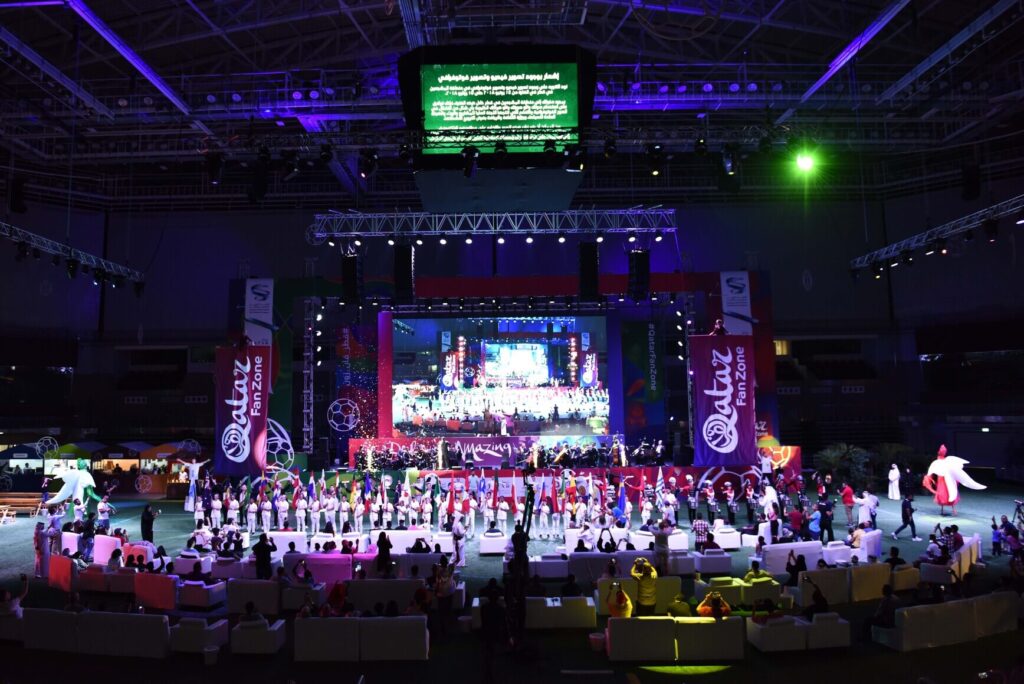
The finale is often the most photographed moment of the show.
Lighting needs to support both atmosphere and visibility.
The team should understand where cameras are positioned and ensure that the final state gives performers enough definition.
A visually dramatic silhouette may work for one moment but provide limited documentation if every face disappears.
Build Scale Gradually
If the entire show operates at maximum scale, the finale cannot feel larger.
Creative direction needs contrast.
The production might progress through:
- Intimacy
- Expansion
- Reduction
- Rebuilding
- Full resolution
Scale becomes meaningful because it changes.
Save Something for the End
A strong finale often introduces one element that has not been fully experienced earlier.
This could be:
- A performer group
- A musical layer
- A scenic transformation
- A costume element
- A lighting state
- A visual reveal
The element does not need to be surprising for the sake of surprise.
It simply gives the ending something new.
Repetition Can Create Emotional Payoff
A movement first seen at the beginning can return in the finale.
The difference is context.
A gesture performed by one person early in the show may return across the entire ensemble.
A simple melody may become orchestral.
A small visual symbol may expand across the stage.
Repetition becomes transformation.
Customized Shows Need Customized Endings
A generic performance often has a standard finale.
A customized live show can design the ending around the specific event.
For a ceremony, the finale may communicate unity.
For a launch, it may transfer attention to the product.
For a cultural performance, it may bring several artistic traditions into one composition.
For a brand event, it may resolve into a visual world associated with the brand.
The ending belongs to the purpose.
Ceremonies Need Symbolic Resolution
Opening and closing ceremonies often carry broader themes.
The finale can bring those themes into one final image.
Separate groups may converge.
A central scenic symbol may complete its transformation.
Music may combine themes introduced earlier.
The audience sees the central idea resolved rather than simply watching the performers take their final positions.
Product Launches Need a Different Ending
For brand and product launch entertainment, the performance itself may not be the final focus.
The product can become the finale.
In that case, performers, lighting, music and scenery need to direct attention toward it.
The strongest ending may actually involve performers moving away from the center.
Their role is complete once the product owns the stage.
Cultural Shows Need Respectful Resolution
A cultural show may contain several movement, musical or visual references.
The finale should avoid reducing those references into an artificial mixture purely for spectacle.
Instead, the creative direction can identify a shared compositional idea that allows each element to remain recognizable.
Unity does not require sameness.
International Acts Need Integration
When international performances appear within a larger production, the finale may need to connect them with other performers.
This requires rehearsal.
Different acts may have different movement styles, stage habits and technical requirements.
The final composition needs to feel intentional rather than like everyone was simply asked to return to the stage.
Transitions Determine Whether the Finale Feels Earned
A strong ending can be weakened by an awkward transition into it.
The final section should emerge naturally from the previous scene.
Music may begin changing before the visual transformation.
Performers may gradually reposition.
Lighting may shift focus.
The audience feels acceleration toward the finale without seeing the machinery behind it.
The Final Minute Needs Detailed Cueing
A complex finale may contain many cues in very little time.
These can include:
- Music
- Lighting
- Video
- Performer movement
- Scenic automation
- Special effects
- Camera direction
Cue timing needs precision.
One early effect can reveal the ending before the performance reaches it.
Special Effects Need a Reason
Confetti, pyrotechnics, CO2 and other effects can create scale.
They can also become predictable.
A finale should not use an effect only because finales traditionally use it.
The effect needs to support the emotional and visual direction.
Sometimes no special effect is the stronger choice.
Rehearsal Reveals Whether the Ending Is Too Long
A finale can lose impact if it continues after its strongest image.
Creative teams sometimes add several endings:
A large formation.
Then another musical section.
Then a second visual effect.
Then another pose.
The audience has already experienced the resolution.
Knowing when to stop is part of direction.
Applause Needs Space
A performance should give the audience a clear moment to respond.
If music immediately transitions into another program segment, applause can become awkward.
The final image should communicate completion.
Then the production can allow a brief response before moving forward.
The Exit After the Finale Matters
What happens after the final pose?
Performers may:
- Exit
- Remain in place
- Transition into another scene
- Lead into a speaker
- Frame a product
- Join a closing ceremony
The exit should be planned.
A strong final image followed by disorganized movement can weaken the memory of the ending.
Camera Direction Needs the Final Formation
The broadcast and documentation teams should know exactly what the final composition will be.
A wide camera may capture the complete stage.
Another camera can focus on the lead performer.
A moving camera may reveal the scale gradually.
The performance and camera plan should support the same conclusion.
The Audience Needs One Memory
A finale does not need to summarize every scene.
It needs to leave one strong impression.
The best final image often contains the essence of the production rather than every detail.
This gives the audience something clear to remember.
Scale in Dubai Needs Control
Large event productions in Dubai can involve extensive stages, large casts and advanced technical systems.
That creates significant finale possibilities.
It also creates the need for restraint.
Every available system does not need to fire simultaneously.
The strongest ending may use only the layers that serve the final idea.
Emotional Resolution Matters More Than Technical Resolution
A stage can complete every technical cue perfectly and still leave the audience emotionally uncertain.
The finale needs to resolve the experience, not only the production sequence.
Music, movement and imagery should communicate that something has reached completion.
The audience should feel the ending before they intellectually analyze it.
The Final Cue Is Prepared From the First
A memorable finale is not a decoration attached to the last minute.
It is the destination of the entire performance.
The opening establishes information.
The middle develops it.
The production changes scale.
Themes return.
Visual relationships evolve.
Then the final image brings those elements together.
For live productions in Dubai, that preparation is what allows the last cue to feel inevitable rather than simply impressive.
The finale works because the show has earned it.
Frequently Asked Questions
When should a live show finale be designed?
The final image and emotional objective are useful to define early so the rest of the performance can build toward them.
Does a finale need special effects?
No. Lighting, music, movement, scenic transformation or even controlled stillness can create a strong ending without additional effects.
Why is the final formation important?
It gives choreography a visual destination and creates a clear image for both the audience and cameras.
Can a quiet finale be effective?
Yes. Silence, reduced lighting and stillness can create strong emotional impact when they suit the production.
How long should performers hold the final image?
The duration depends on the show, but it should be long enough for the audience and cameras to read the composition clearly.
Build a customized live show where every creative layer develops toward one clear, memorable final image.
Explore Customized Live ShowsYou May Also Like