Original Music Gives Ceremonies Their Own Identity in GCC & Middle East
A major ceremony can have an impressive stage, sophisticated lighting and an extensive cast, yet still feel incomplete without a clear musical identity.
Music provides continuity between visual moments. It establishes emotional direction, creates anticipation and gives individual scenes a relationship to the larger production.
When a ceremony uses original music, that relationship becomes even more deliberate.
Rather than selecting unrelated tracks to accompany different sections, the creative team can develop a musical language specifically for the event.
For major productions in GCC & Middle East, original composition offers an opportunity to connect cultural context, event purpose and contemporary performance through one cohesive score.
The approach is especially relevant to across the GCC & Middle East, where musical direction needs to support the wider creative concept rather than function as background accompaniment.
A Ceremony Needs More Than a Playlist
A playlist can provide atmosphere, but a ceremony usually requires a more structured musical approach.
Different moments have different responsibilities.
The opening may need to establish anticipation. A historical sequence may require emotional depth. A reveal may demand precision, while the closing section may need a sense of resolution.
Using unrelated tracks for these moments can create abrupt changes in style.
Original composition allows the entire program to share recognizable musical characteristics.
The Musical Brief Comes First
Before composing begins, the creative team should define the event’s purpose.
A useful musical brief identifies:
- The central message
- The event’s cultural context
- The intended emotional tone
- The approximate performance duration
- The number of scenes
- The role of live musicians
- The relationship between music and movement
- The technical production environment
These details help the composer understand what the score needs to accomplish.
Without a clear brief, even excellent music may fail to support the event.
Establishing a Recognizable Musical Theme
A musical theme gives a production an identity.
It may consist of a short melody, rhythmic pattern or harmonic idea.
The theme does not need to appear continuously.
Instead, it can return at important moments in different forms.
For example, a melody introduced by a single instrument during the opening might later return through a full orchestra.
The audience hears a familiar idea, but its emotional scale has changed.
This creates continuity without requiring every scene to sound identical.
Composition and Arrangement Serve Different Purposes
Composition involves creating the underlying musical material.
Arrangement determines how that material is presented through instruments, voices and musical textures.
A single composition can support several arrangements.
An intimate version might feature a solo oud or piano.
A ceremonial version could use strings, percussion and brass.
A contemporary interpretation might introduce electronic textures.
The melody remains recognizable while the arrangement changes its character.
This flexibility is valuable in musical productions that need to connect multiple scenes.
Cultural References Need Musical Understanding
Music associated with cultural identity should be developed through research and artistic collaboration.
Traditional instruments, rhythmic structures and melodic practices carry specific meanings.
A composer should understand those characteristics before incorporating them into a contemporary score.
For ceremonies in GCC & Middle East, the objective is not simply to add a regional instrument to an otherwise unrelated composition.
The musical reference should contribute meaningfully to the work.
Beyond Decorative Instrumentation
Including an oud, qanun or traditional percussion instrument does not automatically make a composition culturally authentic.
The instrument’s musical role matters.
Its phrasing, rhythm and interaction with the rest of the ensemble should be considered.
A respectful contemporary arrangement can combine traditional and modern musical languages while preserving the character of the original reference.
Orchestration Determines Musical Scale
Orchestration concerns the distribution of musical material across instruments.
The same theme can feel completely different depending on the ensemble.
A small group of strings may create intimacy.
A large orchestra can communicate scale and ceremony.
Percussion can introduce urgency.
Woodwinds may provide delicacy, while brass can add weight to a major reveal.
The orchestration should reflect the event’s dramatic structure rather than remain at maximum intensity throughout.
Live Musicians Create a Different Stage Presence
Recorded music offers consistency and technical control.
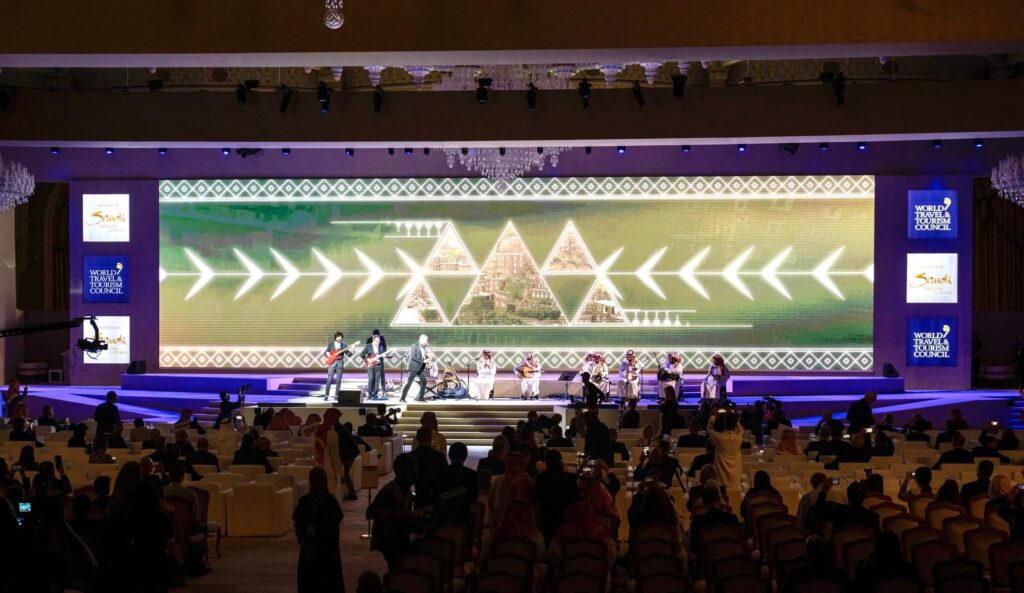
Live musicians add a visible performance dimension.
Their presence can become part of the stage composition.
A conductor’s movement, the synchronized gestures of string players and the physical energy of percussionists contribute visually as well as musically.
This can be especially effective when the orchestra is integrated into the scenography rather than placed in an unrelated corner of the venue.
Designing the Orchestra Into the Stage
The physical location of musicians affects the production.
An orchestra may appear:
- Across the main stage
- On an elevated platform
- Within an architectural scenic structure
- Partially concealed until a reveal
- In separate instrumental groups
Each arrangement creates different technical and creative requirements.
Sightlines, acoustic conditions, monitoring, microphone placement and performer movement need to be planned together.
Music and Choreography Share a Timeline
Choreography depends on musical structure.
Performers may move according to beats, phrases or specific musical cues.
When original music is being developed, choreographers and composers should collaborate early.
A movement sequence may require an additional musical phrase.
A scenic transition may need a longer instrumental passage.
A dramatic gesture may benefit from a moment of silence.
These adjustments are easier when the score is created specifically for the production.
Timing Should Remain Intentional
A ceremony may contain tightly synchronized elements.
Music can coordinate lighting, projection, scenic automation and performer movement.
The score therefore needs a reliable structure.
In some productions, playback systems, click tracks or timecode can help synchronize the musical and technical departments.
The technology should support the performance without removing its artistic character.
The Importance of Musical Transitions
A ceremony rarely consists of one uninterrupted musical performance.
It may include speeches, films, announcements, scenic transformations and live artistic sequences.
The transitions between these elements need attention.
A short musical bridge can connect two different scenes.
A sustained instrumental texture may support a scenic change.
A carefully timed ending can create space for a speaker.
These details prevent the program from feeling like a series of disconnected segments.
Silence Is Part of Musical Direction
Music does not need to occupy every second.
Silence can create focus.
After a powerful orchestral section, a brief pause may make the next visual moment more significant.
A silent scenic reveal can feel more controlled than one accompanied by continuous music.
The decision should follow the emotional needs of the production.
Silence becomes meaningful when it is intentionally placed within the score.
Creating an Emotional Progression
A strong musical production changes over time.
If every section is equally loud, fast and dramatic, the audience has little opportunity to recognize contrast.
The score should contain different levels of intensity.
One possible progression includes:
- A restrained musical introduction
- Gradual expansion through additional instruments
- A more rhythmic central section
- A quieter reflective passage
- A final return to the main theme
This structure is only one example.
The appropriate progression depends on the event’s narrative.
Original Music for Opening Ceremonies
Opening ceremonies have a particular responsibility.
They introduce the event’s identity and establish its emotional scale.
The opening score can communicate confidence, cultural character or anticipation before any spoken explanation begins.
For an international conference, the music may need to balance formality with contemporary energy.
For a cultural celebration, it may draw from a more specific musical heritage.
The composition should reflect the occasion rather than follow a generic ceremonial formula.
Musical Identity Across Multiple Scenes
Large opening and closing ceremonies may include several artistic disciplines.
Music can become the element connecting them.
A visual sequence inspired by history might use an orchestral interpretation of the central theme.
A contemporary movement section could introduce electronic rhythms.
A final ensemble performance might combine both languages.
The result is a coherent musical world rather than several independent soundtracks.
Working With Vocalists
Vocals introduce another layer of meaning.
A vocalist may deliver lyrics, wordless melodies or traditional musical phrases.
The choice depends on the creative concept.
Lyrics require particular attention because they introduce language and explicit meaning.
A wordless vocal line can communicate emotion without adding another verbal message.
Vocal direction should consider the venue, musical arrangement and wider performance.
Recording Versus Live Delivery
Not every ceremony requires a fully live orchestra.
Some productions use recorded music.
Others combine live musicians with prepared tracks.
Hybrid arrangements can provide flexibility, particularly when electronic textures or complex synchronization are involved.
The decision should consider:
- Creative objectives
- Available rehearsal time
- Venue acoustics
- Technical requirements
- Budget
- Number of musicians
- Reliability of playback and monitoring
The strongest format is the one that supports the intended performance.
The Role of Sound Design
Music and sound design are related but distinct.
Sound design may include environmental textures, transitions, atmospheric effects and other sonic elements.
These sounds can support the score.
For example, an opening scene may begin with a subtle environmental sound before the first musical note.
A transition may combine sound design with a developing orchestral phrase.
The two departments should share one creative direction.
Music for Brand-Led Ceremonies
Corporate and brand events can benefit from original musical identity.
A brand may already have a recognizable sonic signature.
That signature can be developed into a larger composition.
Alternatively, a new musical theme can reflect the values and tone of the occasion.
The objective is not necessarily to create an advertising jingle.
It is to establish a musical identity appropriate for a live event.
Technical Preparation Protects the Score
Original music requires careful technical planning.
The team needs to understand the playback system, audio routing, monitoring, microphones and communication between musical and technical departments.
Live musicians may require separate monitor mixes.
A conductor may need visual or audio references.
Playback operators must understand the cue structure.
These requirements should be resolved before the final rehearsal.
Rehearsal Makes the Music Physical
A composition can sound complete in a studio but behave differently on stage.
Musicians may need to adapt to the venue.
Choreography may require timing adjustments.
Scenic changes may take longer than anticipated.
Rehearsal allows the creative team to refine the relationship between music and physical action.
This is especially important when the score supports customized live shows involving several artistic disciplines.
Music Needs to Work for the Camera
Large ceremonies are frequently documented or broadcast.
The sound mix should account for that.
Music that feels balanced inside a venue may require a different treatment for recorded content.
The production should consider both the live acoustic experience and the final documentation.
Clear communication between musical direction, sound engineering and broadcast teams is essential.
Musical Identity Can Extend Beyond the Event
Original music can have a life beyond the ceremony itself.
Depending on the rights and agreements, a composition may be adapted for future promotional films, event recaps or related productions.
This can help maintain continuity across a larger campaign.
However, usage rights, recording permissions and ownership should be clarified during the production process.
Original composition does not automatically mean unrestricted future use.
A Distinctive Sound for GCC & Middle East
Major ceremonies in GCC & Middle East often combine cultural references with contemporary production.
Original music provides a way to bring those elements together.
The composition can acknowledge heritage without relying entirely on familiar recordings.
It can introduce modern instrumentation without losing cultural character.
It can also connect performers, visuals and scenic transformations through one musical structure.
The Score Becomes Part of the Event’s Identity
A memorable ceremony is not defined only by what the audience sees.
Its sound contributes to how the experience is remembered.
A recurring melody can become associated with a particular occasion.
A distinctive orchestral arrangement can give a major reveal its character.
A carefully designed musical progression can connect scenes that would otherwise feel unrelated.
For productions in GCC & Middle East, original music offers the opportunity to create something specific to the event rather than borrowing an identity from another production.
When composition, arrangement, performance and technical direction work together, the score becomes part of the ceremony’s creative foundation.
It is no longer simply music accompanying the event.
It is music that belongs to it.
Frequently Asked Questions
Why use original music for an opening ceremony?
Original music allows the score to reflect the event’s specific identity, cultural context, emotional direction and performance requirements.
What is the difference between composition and arrangement?
Composition creates the musical material, while arrangement determines how that material is performed through instruments, voices and textures.
Can traditional instruments be combined with an orchestra?
Yes. Traditional and orchestral instruments can work together when the arrangement respects their musical characteristics and supports the creative concept.
Does a ceremony need a live orchestra?
Not necessarily. Recorded music, live musicians and hybrid arrangements can all be appropriate depending on the production.
Can original music be reused after the event?
Potentially, but future usage depends on the rights and agreements established for the composition and recordings.
Create an original musical production where composition, arrangement, live performance, and technical direction form one distinctive event identity.
Explore Musical ProductionsYou May Also Like