A Show in Layers in GCC & Middle East
A strong performer can hold attention.
A powerful piece of music can create emotion.
Beautiful lighting can change the atmosphere.
A striking costume can create immediate visual identity.
A scenic structure can transform the stage.
A screen can carry a story.
But a complete live show rarely depends on only one of these things.
The strongest performances are built in layers.
Each layer adds information to the audience experience. Music creates rhythm. Movement gives the rhythm physical form. Costume gives performers visual identity. Lighting guides attention. Scenic design creates the environment. Screens or projection add visual depth. Sound reinforces emotion. Timing controls when each layer becomes important.
In GCC & Middle East, live events are becoming more visually sophisticated. Audiences are familiar with high-quality screens, lighting systems, performers, cinematic content, and international entertainment formats.
Adding more technology or more performers is not enough.
The layers need to belong together.
For customized live shows, this integration is what separates a collection of attractive elements from a complete show world.
Soul Kulture develops layered live productions across the GCC & Middle East, helping events in GCC & Middle East connect performance, movement, music, lighting, visuals, costume, scenic direction, and timing into one coherent experience.
A strong show is not defined by the number of layers.
It is defined by how clearly they support one another.
The First Layer Is the Idea
Before music, costume, screens, performers, or lighting are selected, the show needs a central idea.
This idea does not need to be complicated.
It needs to be clear.
The creative concept determines why the performance exists and what the audience should feel. Without this foundation, additional production layers can easily become decoration.
In GCC & Middle East, event concepts may come from a brand message, occasion, product, cultural reference, destination, institutional milestone, creative theme, or emotional objective.
The concept should guide questions such as:
- What does the show represent?
- What emotion should dominate?
- What kind of movement belongs to it?
- Should the visual world feel minimal or layered?
- Does the music need to feel cinematic, intimate, cultural, or modern?
- What role should technology play?
- How should the performance begin?
- What should the final image communicate?
For brand and product launch entertainment, the concept may come directly from the product or brand identity.
The layers should express that idea rather than compete with it.
Movement Creates the Physical Layer
Movement is how the show occupies space.
It may be choreography, procession, stage blocking, performer formations, gestures, scenic movement, or the movement of focus from one area to another.
In GCC & Middle East, movement needs to reflect both the concept and the venue.
A performance built around precision may use controlled geometry. A show built around fluidity may use continuous pathways. A luxury event may use slower, restrained movement. A ceremony may use symmetrical formations and symbolic gestures.
Movement gives the show:
- Shape
- Direction
- Energy
- Scale
- Rhythm
- Focus
- Transition
- Visual memory
For opening and closing ceremonies, group movement can create images that communicate meaning across a large audience.
Movement is not only what performers do between poses.
It is one of the main ways the audience understands the show.
Music Creates the Emotional Layer
Music tells the audience how the movement should feel.
The same performer sequence can appear elegant, dramatic, mysterious, celebratory, or emotional depending on the sound underneath it.
In GCC & Middle East, music can also help different sections of a performance feel connected. A repeated theme can return during the finale. A cultural instrument can give the production a sense of place. A cinematic score can give scale. Live musicians can add presence.
Music direction can include:
- Original composition
- Existing music
- Live instruments
- Vocals
- Percussion
- Ambient sound
- Musical themes
- Transitions
- Reveal cues
- Closing music
For musical productions, music may become the primary layer around which movement and visuals are developed.
The important point is alignment.
The audience should never feel that the music and movement belong to different shows.
Costume Creates Character
Costume helps define who the performers are inside the show world.
It can make them feel elegant, futuristic, ceremonial, sculptural, cultural, playful, minimal, powerful, or mysterious. It also helps groups remain visually readable inside large venues.
In GCC & Middle East, costume needs to work under real production conditions.
Fabric reacts to movement.
Color reacts to light.
Reflective materials react to screens.
Silhouettes change depending on audience distance.
Costume direction should consider:
- Concept
- Performer movement
- Lighting palette
- Scenic materials
- Brand colors
- Venue scale
- Cultural context
- Camera content
- Comfort
- Safety
- Final group composition
For luxury brand events, costume should reflect the quality and personality of the wider brand environment.
A costume should never look as though it was selected independently from the stage world.
It should belong to the same visual language.
Lighting Creates Focus
A layered show can become confusing if everything is visible at once.
Lighting creates hierarchy.
It tells the audience where to look. It can hide one layer while another becomes important. It can isolate a performer from a screen. It can reveal scenic depth. It can change the emotional temperature of the stage.
In GCC & Middle East, lighting becomes especially important when a performance includes screens, multiple performers, scenic elements, musicians, or large venues.
Lighting can control:
- Performer visibility
- Scenic emphasis
- Screen balance
- Emotional mood
- Entrances
- Transitions
- Product reveals
- Final images
- Audience attention
- Camera exposure
A show may contain many layers.
But the audience should not have to process all of them simultaneously.
Lighting helps decide which layer leads.
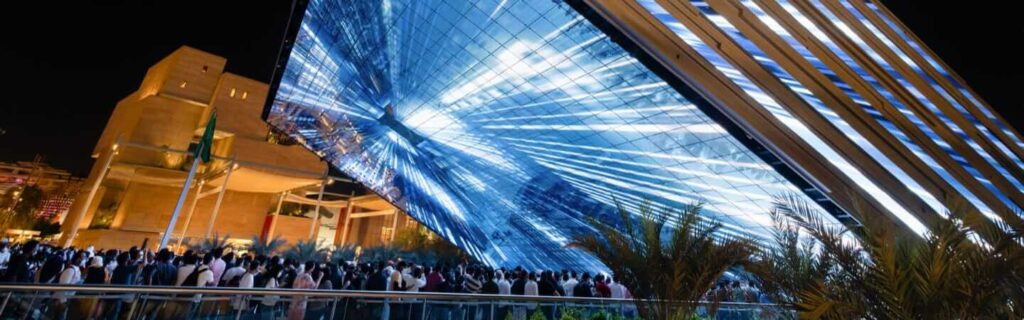
Screens Add a Moving Visual Layer
Screens, projection, and digital content can expand the visual world of a performance.
They can create environments that would be impossible to build physically. They can show abstract motion, brand worlds, cultural imagery, changing landscapes, product visuals, textures, or cinematic sequences.
But digital visuals can easily overpower live performers.
In GCC & Middle East, large LED screens are common in corporate events, ceremonies, launches, and high-production entertainment. Their scale means they naturally attract attention.
Screen content needs restraint.
It should consider:
- Motion speed
- Brightness
- Color
- Performer contrast
- Costume
- Stage composition
- Music
- Lighting
- Camera exposure
- Story progression
For interactive and immersive experiences, screens or projection may extend beyond the stage and into the wider environment.
The digital layer should make the live layer stronger.
It should not make the performers look like small figures in front of a giant television.
Scenic Design Gives the Layers a Home
Scenic design creates the physical world where the other elements live.
Platforms, structures, objects, textures, pathways, frames, stairs, arches, scenic surfaces, and product displays give performers something to move around and visuals something to interact with.
In GCC & Middle East, scenic design should be integrated with performance from the beginning.
A platform may create a stronger final formation.
A scenic object may hide a reveal.
A frame may focus the audience’s attention.
A staircase may create an entrance.
A reflective surface may extend lighting.
Scenic design can support:
- Performer levels
- Visual depth
- Entrances
- Product reveals
- Projection surfaces
- Stage composition
- Camera framing
- Symbolism
- Final images
The scenic layer should not exist only to make the stage look full.
It needs a functional or emotional role.
Sound Effects Create Detail
Music provides the broad emotional structure.
Sound effects can create detail.
A mechanical sound may support a futuristic reveal. A breath, heartbeat, environmental texture, vocal sample, impact, or subtle atmospheric sound can make the visual world feel more complete.
In GCC & Middle East, sound design can help transitions and small stage actions feel intentional.
Sound effects can support:
- Performer entrances
- Scenic movement
- Lighting changes
- Product reveals
- Projection cues
- Gestures
- Transitions
- Finale moments
- Environmental atmosphere
These sounds should be used carefully.
Too many effects can make the show feel artificial.
A well-placed sound can make one visual action feel much larger.
Timing Controls When the Layers Meet
The most important layer may be timing.
A lighting cue can be beautiful, but not if it happens before the performer reaches the mark.
A screen animation can be powerful, but not if it reaches its climax before the music.
A scenic reveal can be impressive, but not if the audience is still looking somewhere else.
A costume may reflect light beautifully, but only if the lighting state appears at the right second.
In GCC & Middle East, complex live shows need detailed cue planning.
Timing aligns:
- Music
- Movement
- Lighting
- Screens
- Scenic actions
- Performer entrances
- Sound effects
- Host lines
- Special effects
- Final poses
For customized live shows, these cues can be built specifically around the event.
When timing is right, several different disciplines appear to behave like one system.
The audience sees one moment.
The production team sees many layers meeting at the same second.
Too Many Layers Can Weaken the Show
Layering does not mean adding everything.
A show can become overloaded.
Screens move continuously. Lights change constantly. Performers fill every part of the stage. Scenic objects compete for attention. Music remains at maximum intensity. Costumes contain too many visual details.
The audience no longer knows what matters.
In GCC & Middle East, restraint is particularly important for luxury and corporate events where clarity often creates more impact than excess.
Creative direction should decide:
- Which layer leads each scene
- Which layers should remain quiet
- When screens should stop moving
- When performers need clean light
- When music should become minimal
- When scenic elements should disappear visually
- When the stage needs negative space
- When silence is more powerful
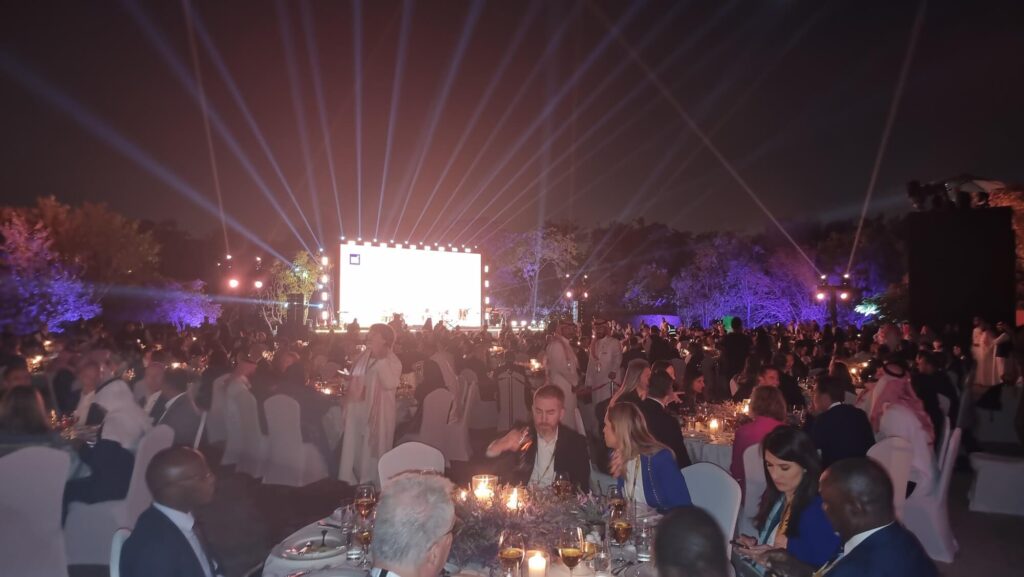
For gala dinner entertainment, layered production should still respect the atmosphere of the room.
Complexity should exist behind the experience.
The audience should receive clarity.
Transitions Reveal the Quality of Integration
A show may look beautifully integrated during its main scenes but fall apart during transitions.
This is where the layers are tested.
How does the lighting move into the next section? What happens to the screen? Where do performers go? How does the music bridge the change? Does a scenic object move? Does the audience understand where to look?
In GCC & Middle East, transitions should be designed with the same care as headline moments.
A strong transition may use:
- A recurring musical motif
- Slow lighting change
- Screen texture
- Performer movement
- Scenic rotation
- Sound atmosphere
- Controlled blackout
- Narration
- A single visual focal point
The layers should reorganize without making the event feel paused.
The show continues even while its visual structure changes.
Rehearsal Reveals Which Layer Is Too Loud
Creative plans often look balanced in concept documents.
Rehearsal reveals the real hierarchy.
The screen may be brighter than expected.
The costume may disappear against the background.
The music may overpower the movement.
The scenic structure may block performers.
Lighting may flatten visual depth.
A sound effect may distract instead of adding impact.
In GCC & Middle East, rehearsal allows the creative team to reduce, strengthen, reposition, or remove layers.
This can include:
- Lowering screen brightness
- Simplifying content
- Adjusting costume color
- Changing formations
- Refining lighting
- Reducing scenic clutter
- Changing music levels
- Extending transitions
- Moving performers
- Removing unnecessary effects
A layered show improves when the team is willing to edit.
Not every idea needs to survive rehearsal.
Soul Kulture Builds the Whole Picture
Soul Kulture approaches customized shows by designing the relationship between creative layers.
The process begins with the central concept. From there, movement, performers, music, costume, lighting, scenic design, screens, sound, technical cues, and transitions are developed as parts of one performance world.
This approach can include:
- Creative concept development
- Customized performance design
- Casting
- Movement direction
- Music development
- Costume direction
- Lighting concepts
- Scenic design
- Screen and projection direction
- Sound design
- Cue planning
- Rehearsal and refinement
In GCC & Middle East, this helps live productions feel coherent even when they involve complex technical and creative elements.
Soul Kulture considers not only whether each layer is strong.
It considers whether the layers are stronger together.
The Audience Should See One Show
The audience does not need to think about choreography, lighting design, projection systems, costume construction, audio cues, scenic engineering, or stage management.
They should simply feel that everything belongs.
For events in GCC & Middle East, layered show design can create experiences with greater depth, emotion, visual identity, and production value. But those benefits appear only when the layers share one direction.
The music should support the movement.
The light should support the performer.
The costume should belong to the visual world.
The scenic design should support the story.
The screen should add depth.
The cues should arrive at the right moment.
Many disciplines may build the show.
The audience should experience one.
Frequently Asked Questions
What is layered live show design?
Layered show design combines performance, movement, music, costumes, lighting, scenic elements, digital visuals, sound, and timing into one connected live experience.
Why does a customized show need a central concept?
The central concept gives every creative and technical layer a shared direction and prevents the production from feeling disconnected.
Can screens overpower live performers?
Yes. Screen brightness, motion, content, and scale should be controlled so digital visuals support performers rather than compete with them.
Why is lighting important in a layered show?
Lighting creates visual hierarchy and tells the audience which performer, object, or visual layer deserves attention at each moment.
Why does rehearsal matter in layered productions?
Rehearsal reveals whether screens, lighting, music, costumes, scenic elements, sound, or performers are competing and allows the team to rebalance them.
How does Soul Kulture approach layered shows?
Soul Kulture develops the relationship between concept, performers, movement, music, costumes, lighting, scenic design, digital visuals, sound, timing, and rehearsal.
Build a customized live show where every creative and technical layer supports one complete performance world.
Explore Customized Live ShowsYou May Also Like