Original Music Gives Live Productions Their Own Voice in GCC & Middle East
Music is often treated as something that is added to a show.
A track is selected.
Movement is built around it.
Lighting follows the beats.
The performance is then adjusted to fit the duration.
That approach can work, but customized productions have another option.
Music can be created specifically for the experience.
Original composition gives the production control over timing, emotional progression, cultural references, transitions and the exact moment when the show needs to change.
For live productions in GCC & Middle East, this can help an event develop a musical identity that belongs to the occasion rather than sounding like a soundtrack borrowed from somewhere else.
Within across the GCC & Middle East, original music becomes a creative structure that can connect performance, staging and storytelling from the first cue to the final image.
Music Establishes the Emotional World
Audiences often feel the music before they consciously understand the stage.
A low sustained tone can create tension.
A percussion rhythm can create momentum.
A single voice can create intimacy.
A full ensemble can create scale.
The soundtrack therefore begins shaping the audience’s interpretation immediately.
Original Composition Starts With the Brief
A composer needs the same creative understanding as the director.
Before writing music, the team should establish:
- Event purpose
- Audience
- Story
- Duration
- Performance style
- Cultural context
- Emotional direction
- Key reveal or finale
Music created without this context may sound strong independently but fail to support the show.
Duration Becomes Exact
Existing commercial tracks have fixed structures.
A production may need a transition at 47 seconds.
The track may not provide one.
Original music can.
The composer can build the score around the real timing of:
- Entrances
- Choreography
- Scenic movement
- Projection
- Reveals
- Speeches
- Final cues
The soundtrack follows the production rather than forcing the production to follow the soundtrack.
Musical Themes Create Recognition
An original score can establish a recurring motif.
This might be:
- A melody
- A rhythm
- A vocal phrase
- A particular instrument
- A harmonic progression
The motif can return in different forms.
At the beginning, it may be quiet.
Later, it becomes rhythmic.
At the finale, the full ensemble performs it.
The audience experiences continuity even when the scenes change.
Cultural Instruments Need Creative Purpose
Regional instruments can give music a strong connection to place.
But cultural instrumentation should not be added only to make a soundtrack sound “local.”
The musical direction should understand the instrument’s character and role.
A cultural show may use traditional instrumentation more directly.
A contemporary production might integrate the same instrument into an orchestral or electronic environment.
The treatment should follow the concept.
Hybrid Scores Can Connect Past and Present
Many productions need to communicate both heritage and contemporary ambition.
Music is particularly effective at creating that relationship.
A score can combine:
- Traditional instruments
- Orchestra
- Electronic sound
- Percussion
- Vocal textures
- Contemporary production
The objective is not to layer everything at once.
It is to create one musical language from different influences.
Rhythm Shapes Choreography
Choreographers need musical information.
Tempo influences energy.
Accents influence movement.
Pauses create opportunities for stillness.
Changes in rhythm can introduce new formations.
When the music is original, choreographic needs can influence the composition directly.
The collaboration works in both directions.
Choreography Can Also Change the Music
Sometimes movement reveals that a musical section needs adjustment.
A transition may require four more counts.
A performer may need additional time to reach a position.
A scenic mechanism may move more slowly than expected.
With original composition, the music can be revised around these realities.
That flexibility is valuable during development.
Music Can Hide Technical Complexity
A live production often contains technical changes that the audience should not notice.
Scenery needs to move.
Performers need to reposition.
Screens need to transition.
An original musical bridge can support these moments.
The audience hears progression rather than waiting through a technical reset.
Silence Is Part of Composition
Original music does not mean continuous sound.
Silence can be composed intentionally.
A pause before a reveal can increase anticipation.
A sudden stop can focus attention on one physical action.
A quiet moment can make the next musical expansion feel larger.
The absence of sound becomes part of the score.
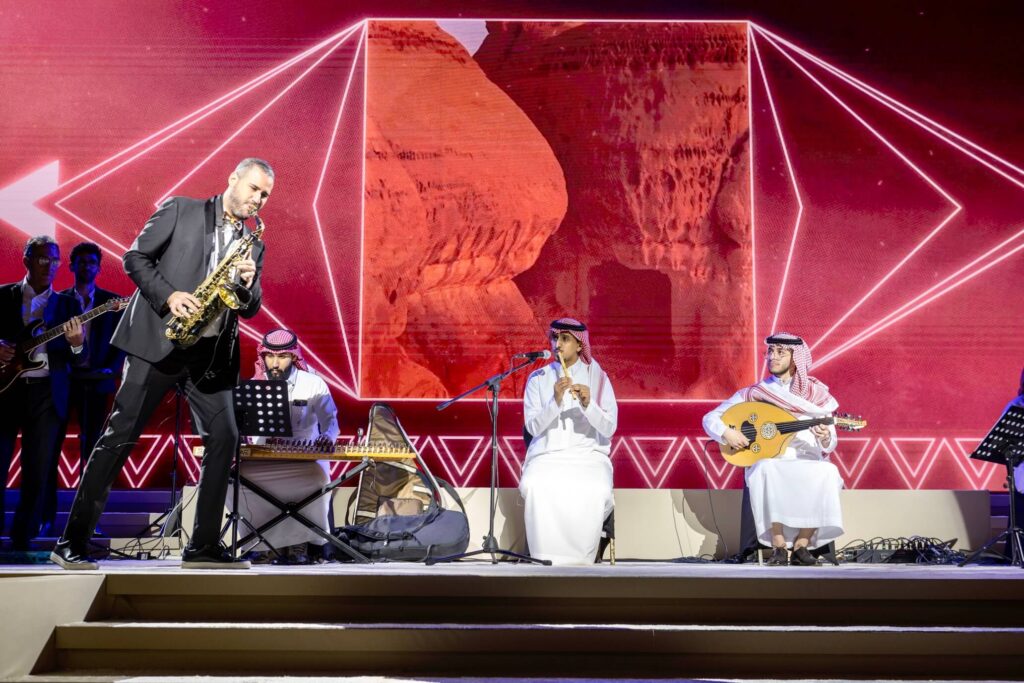
Live Musicians Change the Energy
A musical production may combine pre-produced elements with live musicians.
Live performance adds human variation and visual presence.
Musicians can become part of the stage picture rather than remaining hidden.
Their placement can support:
- Scenic composition
- Cultural identity
- Performer interaction
- Musical authenticity
- Visual rhythm
The musicians become part of the storytelling.
Musicians Need Stage Direction Too
A musician on stage is also a performer visually.
Their entrances, positioning, lighting and relationship with other performers should be directed.
A beautifully composed score can lose visual impact if the musicians appear accidentally placed.
Stage direction brings the musical and visual worlds together.
Vocals Can Carry Narrative
A voice can communicate emotion without requiring full dialogue.
Vocals may use:
- Lyrics
- Vocal textures
- Chants
- Spoken material
- Wordless melody
The choice depends on how much direct meaning the production needs.
A wordless vocal can sometimes communicate across languages more effectively than a detailed lyric.
Lyrics Need Context
When lyrics are used, they become part of the event message.
They should be reviewed with the same care as spoken script.
Language, pronunciation, cultural meaning and tone all matter.
This becomes particularly important for multilingual productions in GCC & Middle East.
Music Can Support Brand Identity
For brand and product events, original music can interpret identity without relying on a familiar commercial song.
A luxury brand may need controlled, minimal composition.
A technology launch may use precision and electronic texture.
A destination event may draw from environmental or cultural references.
Through brand and product launch entertainment, music can become part of how the brand is experienced live.
The Score Should Understand the Venue
A soundtrack that works through headphones may behave differently in a large venue.
Low frequencies can become overwhelming.
Detailed textures may disappear.
Long reverberation can blur rhythmic material.
Composition and sound design should consider the physical environment.
Sound Design and Music Are Related but Different
Not every sound in a production needs to be musical.
Sound design can include:
- Environmental texture
- Mechanical sounds
- Atmospheric effects
- Spoken fragments
- Transitional cues
These elements can interact with the score.
The result becomes a complete sonic world rather than a playlist.
Music Helps Control Pacing
A live production needs rhythm even when nobody is dancing.
Music can control how quickly the audience feels the show is moving.
Short rhythmic sections create momentum.
Sustained sections slow perception.
Silence creates anticipation.
A gradual build creates expectation.
The composer is therefore contributing to dramatic pacing.
Rehearsal Changes the Score
Music should not always be considered finished before rehearsal begins.
Once performers, scenery and technology come together, new timing information appears.
The production may discover that:
- A transition needs longer
- A build happens too early
- A finale needs more space
- A scene feels emotionally rushed
- A pause needs to be extended
Revision allows the music to respond.
Show Calling Needs Clear Musical Cues
Original music can also help technical teams.
Distinct musical moments can support cueing for:
- Lighting
- Video
- Automation
- Performer entrances
- Scenic movement
The show caller can reference recognizable points in the score.
This contributes to repeatability.
The Finale Needs Musical Resolution
A strong final image often depends on a strong musical ending.
The score needs to know whether the production should end with:
- Impact
- Stillness
- Celebration
- Reflection
- Suspense
A generic fade-out rarely gives a customized show the strongest possible ending.
The final sound should feel designed.
Music Can Connect Several Scenes
A show may move between very different visual environments.
Music can preserve continuity.
A melodic motif can survive while instrumentation changes.
A rhythm can reappear at a different tempo.
A vocal texture can return near the end.
These connections help the audience experience one production rather than several separate acts.
Original Does Not Need to Mean Complicated
A bespoke score can be extremely simple.
One instrument may be enough.
One repeated motif may carry the entire performance.
Originality comes from relevance, not quantity.
The music should fit the production so precisely that replacing it with another track would change the experience.
International Collaboration Can Expand the Sound
Productions may involve composers, musicians and performers from different backgrounds.
This can create rich musical possibilities when collaboration is directed clearly.
An international performance can introduce global musical expertise while remaining connected to the event’s local context.
The goal is not to combine influences randomly.
It is to build one coherent sound.
Musical Identity Matters in GCC & Middle East
Events in GCC & Middle East increasingly combine cultural context with contemporary production.
Original music gives creative teams a way to explore that relationship without depending entirely on existing tracks.
Traditional references can be handled carefully.
Contemporary sound can establish modernity.
Live musicians can create human presence.
Electronic production can expand scale.
The score becomes specific to the occasion.
A Production Should Sound Like Itself
The strongest reason to create original music is identity.
A customized live show should have its own visual language.
It should also have its own sound.
When music is created alongside choreography, scenography, performance and technical direction, every department can move toward the same emotional destination.
The audience may never know how many revisions were required.
They simply feel that the music arrives at the right moment.
The movement belongs to it.
The lighting follows it.
The stage changes with it.
The final image resolves through it.
That is when a soundtrack stops being background music and becomes part of the production itself.
Frequently Asked Questions
Why use original music for a live event production?
Original music can be created around the exact timing, emotional direction, choreography and story of the production.
Can original music include traditional instruments?
Yes. Traditional instruments can be integrated when they support the creative and cultural direction of the event.
Does original music need live musicians?
No. A score can be pre-produced, performed live or combine both approaches depending on the production.
Can music change during rehearsals?
Yes. Rehearsal can reveal timing and emotional adjustments that make revisions to the score useful.
How does original music support choreography?
Tempo, accents, pauses and musical transitions can be designed specifically around movement and stage action.
Build a live musical world where composition, performance, staging, and production move together with one creative direction.
Explore Musical ProductionsYou May Also Like