One Symbol Can Give an Opening Ceremony Its Identity in GCC & Middle East
Opening ceremonies often need to communicate something larger than the event itself.
They may introduce a destination, institution, cultural program, conference, competition or national initiative. They may need to acknowledge heritage while looking toward the future. They may need to welcome international audiences while remaining connected to local identity.
That creates a creative challenge.
There can be too many ideas.
When every message becomes a separate scene, the ceremony can feel fragmented.
One central symbol can provide another approach.
A symbol gives the production something to return to. It can influence scenography, music, movement, visual content and the final image without requiring the story to be explained continuously.
For opening ceremonies in GCC & Middle East, symbolism can help complex ideas become visually clear.
Within across the GCC & Middle East, a central creative symbol can function as a shared language connecting performance, stage design and storytelling across the full ceremony.
A Symbol Is More Than a Graphic
A symbol does not need to be a logo projected onto a screen.
It can be an idea expressed physically.
Examples might include:
- A line
- A circle
- A pathway
- A horizon
- A pulse
- A thread
- A geometric form
- A material
- A transformation from darkness to light
The symbol becomes valuable when it can evolve.
Start With Meaning
The creative team should not select a visual symbol because it looks attractive.
It needs to connect to the event.
The starting questions might include:
- What is being opened?
- Why does this moment matter?
- What does the event represent?
- What connects the audience to the occasion?
- What should the final image communicate?
The answers help reveal an appropriate symbolic direction.
Simplicity Makes Symbols Stronger
A complicated symbol can require too much explanation.
A simple one can be understood through repetition.
A line may begin as a beam of light.
Later it appears in choreography.
Then it becomes part of the scenic architecture.
Finally it expands across the full stage.
The audience does not need someone to explain each appearance.
The connection is felt visually.
Scenography Can Make the Symbol Physical
A central idea becomes more powerful when it exists in the room.
Through scenic design, a symbol can become:
- A sculptural object
- A stage opening
- A platform
- A suspended element
- A pathway
- A projection surface
The physical structure gives performers something to interact with.
Choreography Can Translate Shape Into Movement
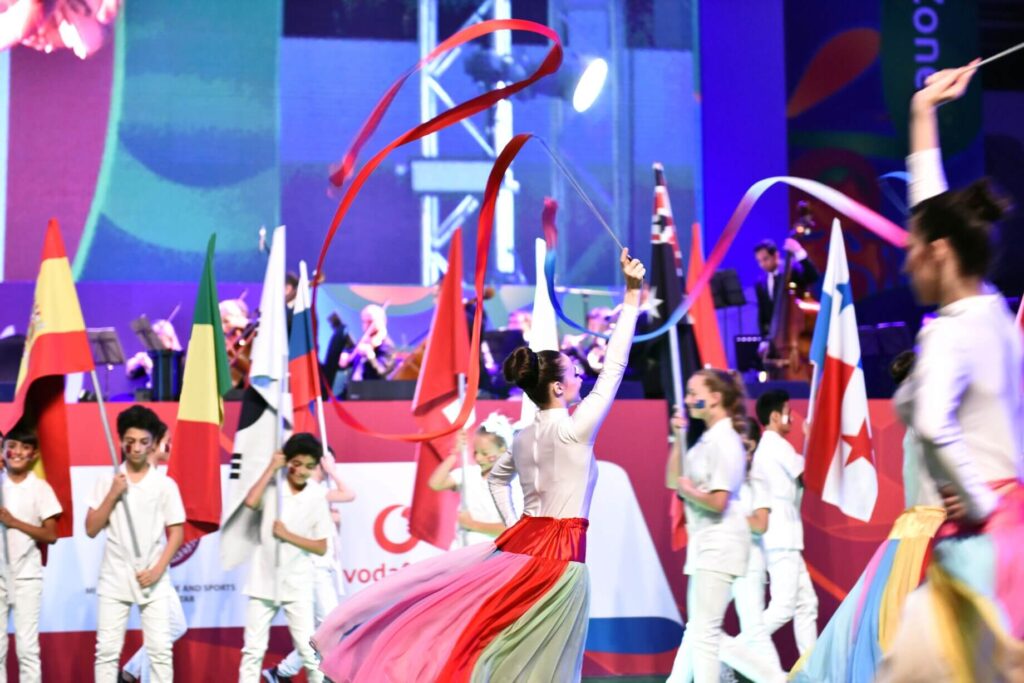
A geometric idea can become a formation.
A pathway can become a procession.
A pulse can become repeated movement.
A circle can expand from one performer to a full ensemble.
The symbol therefore moves beyond scenery.
It enters the body of the performance.
Music Can Carry the Same Idea
Symbols do not need to remain visual.
Music can create an equivalent motif.
A short melodic phrase might return throughout the ceremony.
A rhythm can gradually expand.
A single instrument can become a full orchestral arrangement.
This gives the audience another way to recognize continuity.
Repetition Creates Recognition
The first appearance of a symbol introduces it.
The second builds familiarity.
Later appearances can transform its meaning.
The key is not repeating the exact same image.
It is allowing the symbol to evolve.
For example:
- A small point of light appears
- Performers gather around it
- Projection extends it into a line
- Scenery opens along the same direction
- The final scene expands the line across the venue
The audience experiences development.
Cultural Symbols Require Care
When symbolism draws from culture, history or heritage, research becomes essential.
A cultural reference may carry meanings that are not immediately obvious to every member of the creative team.
The production should understand those meanings before adapting them.
A cultural show can bring traditional forms into contemporary staging while maintaining respect for their context.
The same principle applies to ceremony symbolism.
Avoid Using Heritage as Decoration
A pattern, object or movement should not be included simply because it appears regional.
If it has no connection to the event story, it can feel superficial.
Cultural identity becomes stronger when references have a reason to exist.
The symbol might connect to:
- Place
- History
- Craft
- Landscape
- Collective memory
- Future ambition
Meaning comes first.
Projection Can Transform the Symbol
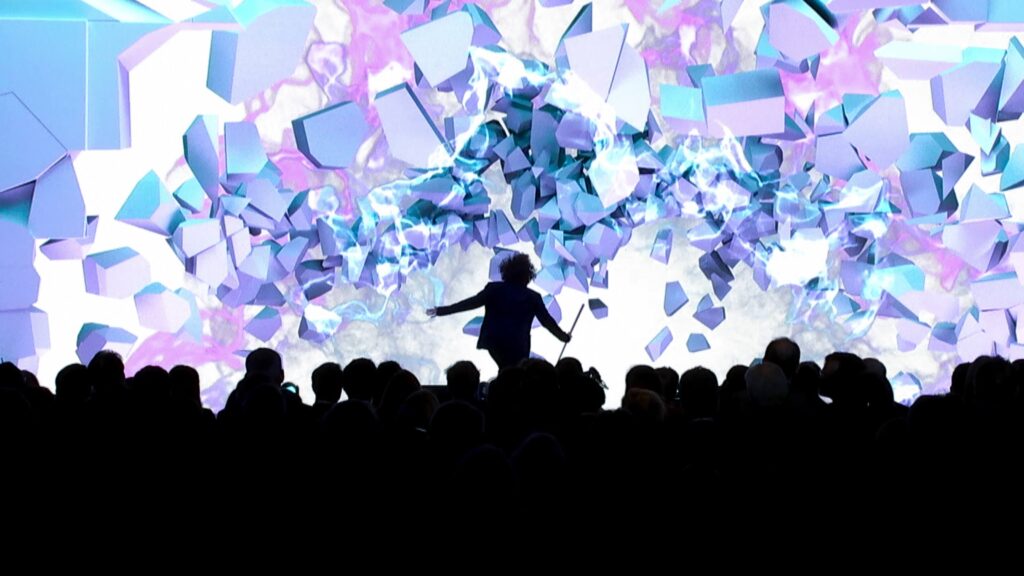
Digital content allows one symbolic form to evolve rapidly.
A physical object may remain stationary while projection changes its appearance.
It can seem to:
- Grow
- Fragment
- Illuminate
- Dissolve
- Multiply
- Transform
This can create narrative development without replacing the physical stage.
Lighting Can Reveal the Symbol Gradually
The audience does not need to see everything immediately.
A scenic symbol may be present from the beginning but hidden in darkness.
Lighting can reveal only part of it.
Later, the full structure becomes visible.
This creates discovery.
Performers Give Symbols Human Scale
A large scenic object can feel abstract until people interact with it.
Performers establish scale and emotional relationship.
They may:
- Approach it
- Move through it
- Surround it
- Carry smaller versions
- Build formations around it
- Reveal it
Human movement turns the symbol into an event.
The Symbol Can Guide Costume
Costume does not need to reproduce the symbol literally.
Instead, it can draw from the same creative language.
A geometric concept may influence:
- Silhouette
- Lines
- Layers
- Texture
- Movement qualities
A material-based symbol may inspire fabric choices.
The connection can remain subtle.
A Ceremony Needs Progression
Symbolism works best when the ceremony changes.
The opening should not look identical to the finale.
A useful structure might move through:
- Origin
- Discovery
- Expansion
- Connection
- Transformation
- Resolution
The symbol accompanies that journey.
Scale Can Increase With Meaning
A symbol may begin small and become larger as the ceremony progresses.
This creates natural escalation.
One performer becomes an ensemble.
One light becomes an architectural state.
One musical voice becomes a full composition.
The production grows because the idea grows.
Not Every Scene Needs the Symbol
Overuse can weaken an idea.
The symbol should disappear when another scene needs space.
Its absence can even make its return more powerful.
Creative direction should decide where the audience needs recognition and where they need contrast.
Speakers and Protocol Need Integration
Opening ceremonies often include formal elements such as speeches, announcements and official protocol.
The symbolic world should not disappear every time a speaker enters.
Lighting, scenic composition and visual content can maintain continuity while giving formal moments appropriate focus.
The ceremony remains one experience.
The Final Image Should Resolve the Symbol
A strong ending brings the idea to completion.
If a line represented connection, the final image might show separate groups becoming one formation.
If the symbol represented transformation, the scenic object may reveal a new form.
If it represented a journey, the final composition may arrive at a clear destination.
The finale should answer what the opening introduced.
Technology Should Serve the Idea
Opening ceremonies can involve advanced technical systems.
Projection, automation, LED, lighting and interactive systems can create extraordinary possibilities.
But technology should not become the concept.
A customized live show becomes stronger when technical tools are selected because they help express the creative idea.
The question should be: what does this technology allow the audience to understand or feel?
The Symbol Helps Departments Collaborate
One advantage of a central creative idea is that different departments can use it as a shared reference.
The choreographer understands the movement language.
The composer understands the musical motif.
The scenographer understands the physical geometry.
The costume team understands the visual world.
The lighting designer understands the progression.
This reduces fragmentation.
Symbols Can Connect Different Performance Disciplines
A ceremony may contain dance, music, theatrical performance and cultural elements.
Without a shared framework, each discipline can feel like a separate act.
A central symbol can connect them without forcing them into the same style.
Each discipline interprets the idea differently.
The ceremony gains variety while maintaining identity.
Local Context Shapes Meaning in GCC & Middle East
A symbol used in GCC & Middle East should make sense within its cultural and social environment.
Local context can influence how audiences interpret colors, objects, movement and visual references.
Creative teams should therefore consider not only what a symbol means internally, but what it may communicate publicly.
This is particularly important for ceremonies representing institutions, destinations and major initiatives.
International Audiences Need Visual Clarity
Opening ceremonies often welcome people from several countries.
A visual symbol can communicate across language differences.
The audience may not understand every spoken word.
They can still follow transformation, connection, growth or movement through a clear visual structure.
This makes symbolism particularly useful for international events.
One Idea Can Support Large Scale
Large-scale ceremonies often contain many technical and creative layers.
A central idea prevents scale from becoming clutter.
The production can include hundreds of cues while still feeling simple at the conceptual level.
The audience does not need to understand the production complexity.
They need to understand the experience.
The Ceremony Should Belong to the Occasion
A successful symbolic concept should be difficult to move unchanged to another event.
Its meaning should connect specifically to the occasion.
The scenic form may respond to the venue.
The movement may draw from the event theme.
The musical development may reflect the story.
The final image may communicate the opening itself.
Specificity creates identity.
Symbolism Creates Memory in GCC & Middle East
The audience may not remember every transition in a ceremony.
They may remember one image.
One object.
One movement.
One transformation.
That image becomes a visual summary of the experience.
For opening ceremonies in GCC & Middle East, a strong symbol can carry cultural context, event purpose and emotional direction without overwhelming the audience with explanation.
The most powerful ceremonies do not necessarily communicate more ideas.
They communicate the right idea more clearly.
Frequently Asked Questions
Why use a central symbol in an opening ceremony?
A central symbol can connect performance, music, scenography, lighting and visual content through one recognizable creative idea.
Does a symbol need to be a physical object?
No. It can be expressed through movement, light, sound, geometry, projection or a combination of several elements.
How can cultural symbolism be used respectfully?
Cultural references should be researched carefully and connected meaningfully to the event rather than used only as decoration.
Can one symbol support a large-scale ceremony?
Yes. A simple central idea can help organize many complex technical and performance layers while keeping the experience visually clear.
Should the symbol appear in every scene?
No. Selective repetition and transformation are usually stronger than constant use.
Create an opening ceremony where performance, scenography, music, and visual storytelling grow from one clear creative idea.
Explore Customized Live ShowsYou May Also Like