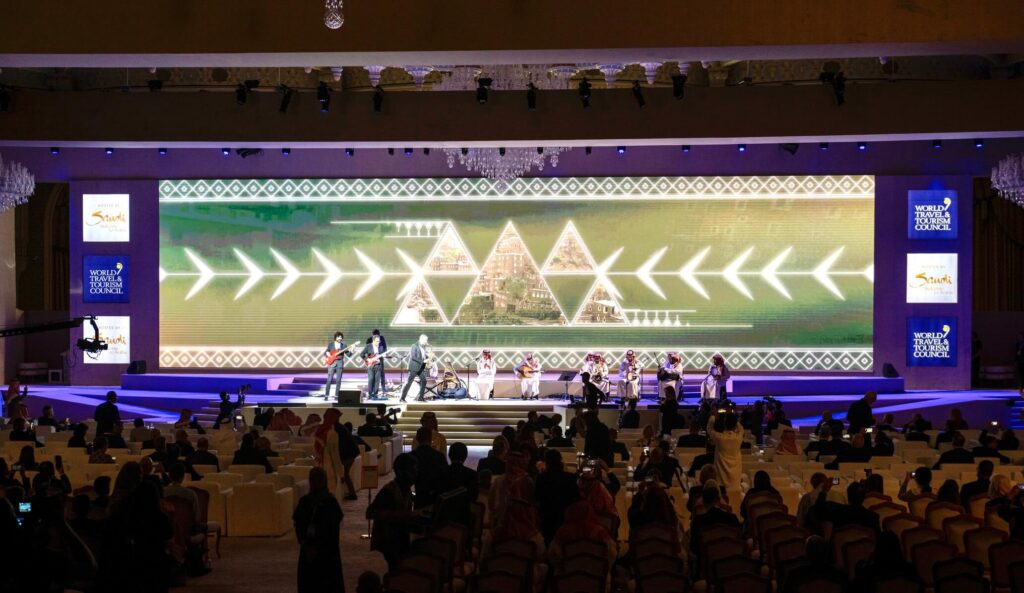
When the Venue Has Its Own Personality in Dubai
Certain spaces quietly support an event.
Others immediately become part of it.
A dramatic landscape, historic building, monumental ballroom, industrial structure, private estate, waterfront terrace, desert setting, cultural site, or unusual architectural interior already has a strong personality before production begins.
Trying to ignore that personality rarely creates the best event.
The stronger approach is to work with it.
In Dubai, events increasingly take place outside traditional hotel stages. Brands, institutions, and private clients are choosing locations because of their atmosphere, architecture, views, history, or sense of place.
These venues create opportunity.
They also create responsibility.
Entertainment should not feel imported into the space without consideration. The performance should understand the venue’s scale, sound, surfaces, light, movement routes, audience layout, and emotional character.
For gala dinner entertainment, the venue can completely change the way entertainment should be approached. A musical performance in a formal ballroom needs different direction from the same performance beside a desert landscape or in a heritage courtyard.
Soul Kulture creates venue-responsive event entertainment across Dubai, Abu Dhabi and Sharjah, helping experiences in Dubai connect performance, music, lighting, movement, atmosphere, and production to the identity of the location.
Sometimes the venue is not where the story happens.
It is part of the story.
Architecture Creates an Emotional Starting Point
Architecture affects emotion before entertainment begins.
High ceilings can create grandeur. Narrow spaces can feel intimate. Stone can feel historic or monumental. Glass can feel modern and open. Curved architecture creates different visual movement from rigid geometry. Large staircases suggest entrances. Courtyards create central gathering points. Long halls create procession.
In Dubai, venue architecture should influence the creative direction instead of being treated as a neutral container.
The creative team can study:
- Ceiling height
- Architectural symmetry
- Natural focal points
- Columns
- Staircases
- Balconies
- Doors
- Windows
- Existing lighting
- Surface materials
- Audience entry points
- Views beyond the venue
A staircase might become a performer entrance.
A balcony might hold a musician.
An architectural arch may become a natural scenic frame.
A long corridor can become a processional space.
A ceiling feature may influence lighting design.
For luxury brand events, using the architecture intelligently can make the event feel more bespoke. The venue does not need to be covered with additional décor if its strongest characteristics are already visually powerful.
The event can reveal what is already there.
Landscape Changes the Scale of Performance
Outdoor landscapes behave differently from interiors.
A performer standing against a mountain, rock formation, desert, waterfront, garden, or open horizon may appear visually smaller than the same performer on a stage. The landscape creates scale.
This can be beautiful.
But it requires performance direction that understands distance.
In Dubai, destination and outdoor events may use natural surroundings as part of the visual identity. Entertainment needs to remain visible without competing aggressively with the landscape.
This may involve:
- Stronger performer silhouettes
- Elevated positions
- Clear costume color
- Wider formations
- Focused lighting
- Defined performance areas
- Larger movement
- Live music
- Scenic elements that complement the environment
- Reduced visual clutter
For customized live shows, choreography can respond directly to the location. Movement can echo the lines of the architecture or landscape instead of being copied from a generic stage format.
The environment creates the frame.
The performance needs to understand its size inside that frame.
Acoustics Give Every Venue a Different Voice
Venues sound different.
A carpeted ballroom absorbs sound. Stone courtyards can create reflection. High ceilings may produce long reverberation. Outdoor spaces allow sound to escape. Glass surfaces can create harsh reflections. Large rooms need wider sound distribution.
This changes music and performance.
In Dubai, sound planning should begin with the venue rather than with a fixed technical setup.
A solo instrument may sound intimate in one space and disappear in another. Percussion may feel powerful outdoors but become overwhelming in a reflective interior. Spoken narration may need additional control in a large hall.
Venue acoustics influence:
- Music style
- Speaker placement
- Instrument choice
- Vocal amplification
- Sound levels
- Speech clarity
- Performer positions
- Audience comfort
- Transition music
- Technical equipment
For musical productions, venue acoustics can even become part of the creative approach. Natural resonance may enhance certain instruments, while other locations may require more controlled amplification.
The room has its own voice.
The production needs to listen to it.
Existing Light Can Become Part of the Design
Some venues arrive with their own light.
Sunset enters through windows. Architectural fixtures create warmth. Chandeliers establish elegance. Outdoor landscapes shift color throughout the evening. City lights become visible after dark. Heritage buildings may already have dramatic exterior illumination.
Instead of replacing this light entirely, event lighting can build on it.
In Dubai, this can create a more natural and location-specific atmosphere.
Lighting designers may consider:
- Existing chandeliers
- Architectural uplighting
- Sunset timing
- Window direction
- Landscape lighting
- Practical lamps
- Venue color temperature
- Reflections
- Dark architectural zones
- Natural shadows
For a gala dinner, existing warm light may support an intimate atmosphere. The event lighting can then add performer focus, stage clarity, and transitions without changing the entire room.
For opening and closing ceremonies, architecture can also be revealed gradually. Lighting may begin with one part of the venue and expand as the ceremony develops.
The venue should not disappear once event lighting is activated.
Its character should become clearer.
A Strong Venue Does Not Need to Be Covered
One of the easiest ways to weaken a distinctive location is to cover everything that made it distinctive.
Large screens may hide architecture. Heavy scenic construction may block views. Excessive draping may remove material character. Overbranding may make a unique venue look similar to every other event space.
In Dubai, venue-responsive design often requires restraint.
The production team should ask which existing elements already contribute to the event.
Maybe a stone wall is a stronger backdrop than a printed panel.
Maybe a desert horizon is stronger than an LED screen.
Maybe an architectural staircase already creates the perfect entrance.
Maybe the venue ceiling should remain visible rather than hidden under technical structures.
For luxury brand events, this can make the experience feel more premium because the event does not appear to be fighting its setting.
Production should add what the venue needs.
Not erase what gives it value.
Performer Styling Should Belong to the Location
Costume and styling also interact with venue personality.
A highly reflective futuristic costume may look powerful in a modern architectural environment but feel disconnected in a natural landscape. A flowing costume may respond beautifully to an outdoor setting. Refined monochrome styling may complement a luxury interior. Textured materials may connect with stone, wood, sand, or heritage architecture.
In Dubai, performer styling can help integrate entertainment into the location visually.
Styling decisions can consider:
- Venue colors
- Material textures
- Lighting temperature
- Landscape
- Architecture
- Audience proximity
- Event formality
- Brand identity
- Movement
- Photography
For gala dinner entertainment, performers should feel like they belong in the room rather than appearing as a separate layer.
The audience should not see the venue and performer as two unrelated images.
They should read as one composition.
Entrances Can Use the Venue’s Natural Drama
Distinctive venues often contain natural entrances.
A staircase.
A long corridor.
A monumental doorway.
A terrace.
A balcony.
A hidden pathway.
A bridge.
A landscape ridge.
These locations can create stronger performer entrances than a temporary stage wing.
In Dubai, the venue can therefore influence the show flow.
An entrance from a distance can build anticipation. A musician appearing above the audience can create surprise. A group descending a staircase can feel ceremonial. A performer emerging from the landscape can create a cinematic image.
The route itself becomes part of the entertainment.
Entrance planning should consider:
- Sightlines
- Timing
- Walking distance
- Lighting
- Sound cues
- Costume movement
- Audience position
- Safety
- Camera angles
- Final performer position
A venue-responsive entrance feels inevitable.
It seems as though the architecture was always meant to be used that way.
The Audience Should Feel the Location
Guests often remember where an event happened.
This is particularly true for destination events, unusual venues, cultural sites, outdoor environments, and architecturally distinctive locations.
The entertainment should strengthen this memory.
In Dubai, a guest should not leave a unique venue feeling that the same show could have happened anywhere.
The production can reinforce location through:
- Music
- Lighting
- Performer placement
- Scenic restraint
- Hospitality
- Movement routes
- Natural views
- Material choices
- Sound atmosphere
- Arrival sequence
- Closing moment
For corporate and luxury event entertainment, this sense of place can make the experience feel more exclusive.
The location becomes part of what guests talk about afterward.
Weather Becomes Part of Outdoor Venue Personality
Outdoor venues are not static.
Temperature changes. Wind moves fabric. Natural light fades. The sky becomes darker. Landscape colors shift. Sound behaves differently. Guests move toward warmer or cooler zones.
In Dubai, outdoor entertainment should respond to this changing environment.
A performance may be timed for sunset.
Fire or warm lighting may become more effective later at night.
Costumes may need adaptation.
Live musicians may need protection.
Guest seating may need different orientation depending on temperature or wind.
The venue changes during the event.
The entertainment can change with it.
This makes outdoor events feel alive in a way that indoor spaces cannot always reproduce.
Venue Limitations Can Inspire Better Ideas
Not every location makes production easy.
Rigging may be restricted. Access may be limited. Power may be distant. Scenic construction may not be allowed. Heritage surfaces may need protection. Sound levels may be controlled. Outdoor ground may be uneven. Large equipment may be difficult to transport.
These limits can initially feel restrictive.
But they can also improve creative thinking.
In Dubai, venue-responsive entertainment can find alternatives that preserve the emotional goal.
If rigging is impossible, movement may become floor-based.
If scenic construction is limited, lighting may carry more of the atmosphere.
If screens cannot be installed, architectural surfaces may become visual features.
If sound needs restraint, acoustic performance may become more appropriate.
If a landscape is visually powerful, fewer scenic elements may be needed.
Constraints can help the production identify what truly matters.
Soul Kulture Starts With the Place
Soul Kulture approaches distinctive venues by studying the environment before finalizing the entertainment concept.
What does the location already offer? How does it sound? What does it look like at different times? Where do guests enter? Which architectural details are strongest? What views should remain visible? Where can performers appear naturally? What technical limitations exist?
This approach can include:
- Venue-responsive performance concepts
- Architecture-led entrances
- Landscape performance planning
- Gala dinner entertainment
- Lighting integration
- Sound adaptation
- Costume direction
- Scenic restraint
- Guest journey planning
- Outdoor performance planning
- Rehearsal in the real environment
- Closing atmosphere
In Dubai, this helps events feel connected to where they happen.
The location is not treated as a rented shell.
It becomes part of the creative material.
The Venue Should Be Impossible to Replace
A strong venue-responsive event creates one simple feeling:
This could only have happened here.
The performance belongs to the architecture. The light reveals the material. The music suits the acoustics. The entrances use the space naturally. The costumes fit the visual world. The audience feels the location throughout the experience.
For events in Dubai, this creates a deeper sense of originality.
Instead of taking a standard entertainment format and installing it in a new place, the production is shaped around the place itself.
The venue already has a personality.
The creative work begins by listening to it.
Frequently Asked Questions
What is venue-responsive entertainment?
Venue-responsive entertainment is designed around the architecture, landscape, acoustics, lighting, audience layout, and atmosphere of a specific event location.
Why should entertainment respond to the venue?
It helps the event feel more original, visually connected, practical, and specific to the location rather than using a generic performance format.
Can architecture become part of the performance?
Yes. Staircases, balconies, corridors, doorways, courtyards, terraces, and other architectural elements can support performer entrances and show direction.
How do venue acoustics affect entertainment?
Acoustics influence instrument choice, speaker placement, music volume, speech clarity, and the overall sound experience.
Should distinctive venues still use scenic design?
Yes, but scenic elements should support the location rather than hide the features that make the venue special.
How does Soul Kulture approach distinctive venues?
Soul Kulture studies the venue first and develops entertainment around its architecture, atmosphere, sound, light, movement possibilities, audience layout, and production requirements.
Create entertainment designed around the personality, architecture, atmosphere, and possibilities of your venue.
Explore Gala Dinner EntertainmentYou May Also Like
![Six Flags theme park [image_alt_tag_value]](https://soulkultureevents.com/wp-content/uploads/2026/03/Untitled-design-2-1024x787.jpg)