Spatial Performance Gives Open Venues a Show Identity in GCC & Middle East
A large venue can feel powerful, but it can also feel empty.
An open arena, outdoor ground, festival zone, plaza, ballroom, sports field, heritage site, or public venue gives an event scale. But scale alone does not create emotion. If the space is not directed, the audience may see size without feeling connection. The venue may look impressive, but the live experience can feel unfinished.
Spatial performance changes that.
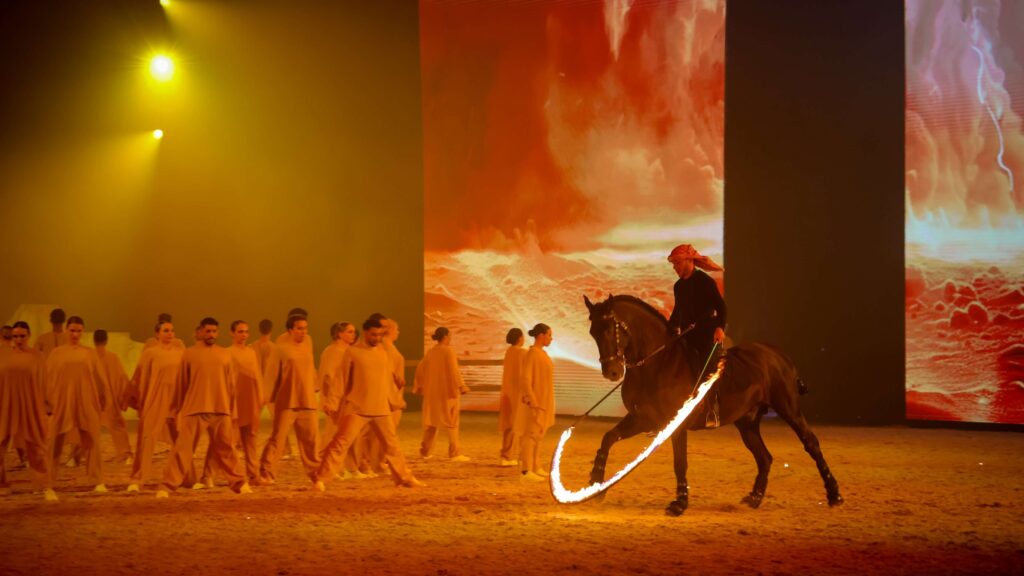
It uses movement, formations, performers, sound, lighting, entrances, pathways, and timing to turn open space into a live show world. Instead of placing entertainment in one fixed spot, spatial performance allows the full venue to become part of the production.
In GCC & Middle East, events are becoming more ambitious in scale and more visual in their execution. Large openings, public celebrations, brand activations, festivals, destination events, and private productions often need entertainment that can fill space without overwhelming it. This requires more than a strong act. It requires direction.
For customized live shows, spatial performance allows entertainment to be designed around the venue itself. The show is not forced into the space. It is built with the space in mind.
Soul Kulture creates spatial live performance experiences across the GCC & Middle East, helping events in GCC & Middle East transform open venues into immersive show worlds shaped by movement, atmosphere, timing, and performance direction.
The Venue Should Not Feel Empty Between Moments
Large spaces often expose weak event flow.
If there is too much distance between performers, guests, stages, or program points, the event can feel scattered. The audience may not know where to look. The energy may feel too spread out. The show may lose impact because the space is not being used with intention.
Spatial performance solves this by giving the venue structure.
Performers can frame a central object, move across different zones, create visual lines, guide audience attention, or reveal the next part of the experience. The space becomes active, even when the main stage is not the only focus.
In GCC & Middle East, this is especially useful for events held in outdoor locations, stadium-style venues, festival grounds, large halls, and destination spaces. These venues need entertainment that can travel visually across the space.
Spatial direction can help answer:
- Where should the audience look first?
- How should the show begin?
- How do performers enter the space?
- What areas need to feel alive?
- How does movement connect one moment to the next?
- Where should the audience feel surprise?
- What should the final picture look like?
When these questions are answered clearly, the venue stops feeling empty.
It starts feeling designed.
Movement Creates Architecture
Performance can build invisible architecture.
A group of performers standing in formation can frame a stage. A moving line can create a pathway. A circular formation can turn an open floor into a central ritual space. A procession can guide attention through the venue. A sudden shift in movement can transform the mood of the event.
This is why spatial performance is powerful.
It creates structure without needing walls. It shapes the audience’s perception of the venue through movement.
In GCC & Middle East, where many events need strong visual moments for both live audiences and digital content, formations can create memorable images. The audience remembers the shape of the show, not only the individual act.
Movement can make a venue feel:
- Larger
- More focused
- More dramatic
- More immersive
- More ceremonial
- More energetic
- More emotional
- More connected
For opening and closing ceremonies, this can be especially important. Ceremonies often need scale, symbolism, and strong visual impact. Spatial performance allows the opening or closing moment to feel bigger than one stage.
It gives the event a visual language.
The Audience Needs Clear Focus
In a large venue, attention can easily break.
Guests may look in different directions. Some may focus on the stage, others on screens, others on performers, and others on the surrounding atmosphere. This can be positive if it is planned. It can feel confusing if it is not.
Spatial performance needs clear focus points.
The audience should understand where the important moment is, even when performers are spread across the space. Lighting, sound, movement, and staging should guide attention naturally.
In GCC & Middle East, this matters for both seated and standing audiences. A gala dinner may need subtle spatial performance around the room. A public event may need stronger visual cues. A festival may need movement that can be seen from different angles. A corporate launch may need performers to guide attention toward a reveal.
Focus can be created through:
- Lighting direction
- Performer formation
- Sound cues
- Movement timing
- Stillness before action
- Repetition
- Central props or objects
- Pathway design
- Visual contrast
- Group choreography
The goal is not to control every guest’s reaction.
The goal is to make the event easy to follow emotionally.
Rehearsal Turns Space Into Precision
Spatial performance may look effortless during the event, but it needs rehearsal.
The performers need to understand the space. They need to know their marks, movement paths, entrances, exits, timing, distances, and visual relationship to the audience. In a large venue, even a small mistake in spacing can change the whole picture.
This is why rehearsal is not a small detail.
It is part of the creative process.
In GCC & Middle East, where events often require polished execution, rehearsal helps protect the impact of the show. It allows the team to test how movement looks from different audience positions, how lighting falls on performers, how sound travels, and how transitions feel in real time.
Rehearsal can reveal:
- If a formation feels too wide
- If performers are too far from the audience
- If a reveal needs more build-up
- If a route is too long
- If lighting misses key movement
- If a transition feels slow
- If the space needs more energy
- If the final image is strong enough
A strong show is not only imagined.
It is refined in the space.
Spatial Performance Can Support Different Event Styles
Spatial performance is not limited to one event type.
It can be dramatic, elegant, cultural, futuristic, artistic, ceremonial, playful, or immersive depending on the concept. The same method can support different event formats because it is built around space, movement, and audience attention.
In GCC & Middle East, spatial performance can work for:
- Opening ceremonies
- Closing ceremonies
- Brand reveals
- Luxury dinners
- Destination events
- Outdoor festivals
- Cultural celebrations
- Public activations
- Corporate experiences
- Private shows
- Immersive productions
- Sports-related events
- Large-scale stage moments
For interactive and immersive experiences, spatial performance can help audiences feel surrounded by the show. Performers can appear around them, guide movement, create zones, or turn the venue into a world that guests move through.
For a luxury event, spatial performance may be quieter and more elegant.
For a festival, it may be energetic and bold.
For a ceremony, it may feel symbolic and structured.
For a brand reveal, it may build anticipation and guide the eye toward the main moment.
The strength of spatial performance is its flexibility.
Stillness Can Be as Powerful as Movement
Not every spatial performance needs constant motion.
Sometimes, stillness creates more tension than movement. A group of performers holding position around a central object can create anticipation. A silent formation before a reveal can make the audience focus. A slow entrance can feel more powerful than a fast sequence.
In GCC & Middle East, where audiences are often exposed to high-energy event visuals, controlled stillness can feel premium. It gives the show confidence. It allows the audience to absorb the atmosphere before the next moment begins.
Strong spatial performance understands when to move and when to pause.
A venue can feel alive even in stillness when the image is intentional.
The audience can feel that something is about to happen.
That anticipation is part of the entertainment.
Lighting and Sound Complete the Space
Movement alone is not enough.
Spatial performance needs lighting and sound to complete the experience. Lighting can define zones, reveal performers, create shadows, guide attention, and change the mood of the venue. Sound can pull the audience into the moment, support movement, and make the space feel emotionally connected.
In GCC & Middle East, lighting and sound are especially important for large venues and outdoor events. Without them, performers may disappear into the space. With the right design, every movement becomes clearer and more powerful.
Lighting can make a formation feel ceremonial.
Sound can make an entrance feel important.
A shift in both can turn a simple movement into a reveal.
This is why spatial performance should be designed with technical direction from the beginning. The creative idea, performer movement, lighting, sound, and venue layout should work together.
The audience should not feel separate pieces.
They should feel one live world.
The Full Space Should Support the Final Memory
Every event needs a final image.
It may be a closing formation, a reveal, a performance climax, a symbolic gesture, a stage picture, a group movement, or a quiet emotional ending. In spatial performance, the final memory often comes from how the full space is used.
The audience may remember the performers spread across the venue. They may remember the lighting changing across the ground. They may remember movement surrounding the main stage. They may remember how the show filled the space from one side to the other.
In GCC & Middle East, this final memory can be important for event impact, media content, guest experience, and brand recall. A strong final picture gives the event a clear emotional ending.
A weak ending can make even a good event feel unfinished.
Spatial performance helps build toward a final image that feels complete.
It makes the event feel resolved.
Soul Kulture Designs Spatial Performance Around the Venue
Soul Kulture approaches spatial performance by studying the venue, the audience journey, the event purpose, and the emotional direction of the show.
Before the performance is built, the space is considered. Where are the strongest sightlines? Where will guests enter? Where does the venue feel empty? Where should the show gather energy? Where should surprise happen? How should performers move? What should the audience remember?
This approach can include:
- Spatial performance concepts
- Performer movement direction
- Formation planning
- Opening and closing sequences
- Venue activation
- Sound and lighting coordination
- Stage and floor planning
- Audience focus design
- Rehearsal direction
- Reveal moments
- Large-scale show flow
- Customized performance production
In GCC & Middle East, this helps events feel more intentional and more complete. The performance is not simply placed into the venue. It is built from the venue.
Soul Kulture considers how movement, atmosphere, performer spacing, timing, lighting, sound, and audience attention come together. This allows the show to feel immersive, polished, and emotionally clear.
A Venue Becomes Memorable When It Performs
The strongest events do not only happen inside a space.
They transform the space.
Spatial performance gives an event the ability to use the full venue as part of the show. It makes open floors feel active, outdoor grounds feel cinematic, large rooms feel connected, and ceremony spaces feel alive.
For events in GCC & Middle East, this approach can turn scale into emotion. It helps the audience feel the size of the event without losing connection. It makes the venue part of the story. It gives movement a purpose and gives space a rhythm.
A venue should not feel like a background.
It should feel like part of the performance.
When spatial performance is designed with purpose, the event becomes more than a program. It becomes a live world that moves, builds, pauses, reveals, and stays in the audience’s memory.
Frequently Asked Questions
What is spatial performance?
Spatial performance is live entertainment designed around the full venue, using movement, formation, lighting, sound, and staging to activate the space.
Why is spatial performance useful for large events?
It helps large venues feel focused, active, and emotionally connected instead of empty or scattered.
What types of events can use spatial performance?
Opening ceremonies, brand launches, festivals, destination events, luxury dinners, cultural events, corporate experiences, and customized live shows can all use spatial performance.
Does spatial performance need a stage?
Not always. It can happen across open floors, outdoor spaces, entrances, pathways, audience areas, or around a central reveal.
Why is rehearsal important for spatial performance?
Rehearsal helps performers understand timing, spacing, movement routes, sightlines, lighting, sound cues, and the final visual impact.
How does Soul Kulture create spatial performance?
Soul Kulture designs spatial performance around the venue, audience journey, performer movement, show flow, atmosphere, and the emotional purpose of the event.
Transform open venues into immersive live show worlds with performance designed around space, movement, and atmosphere.
Explore Customized Live ShowsYou May Also Like
![Falcon and Horse Show [image_alt_tag_value]](https://soulkultureevents.com/wp-content/uploads/2026/03/216A0518-1024x576.jpg)